

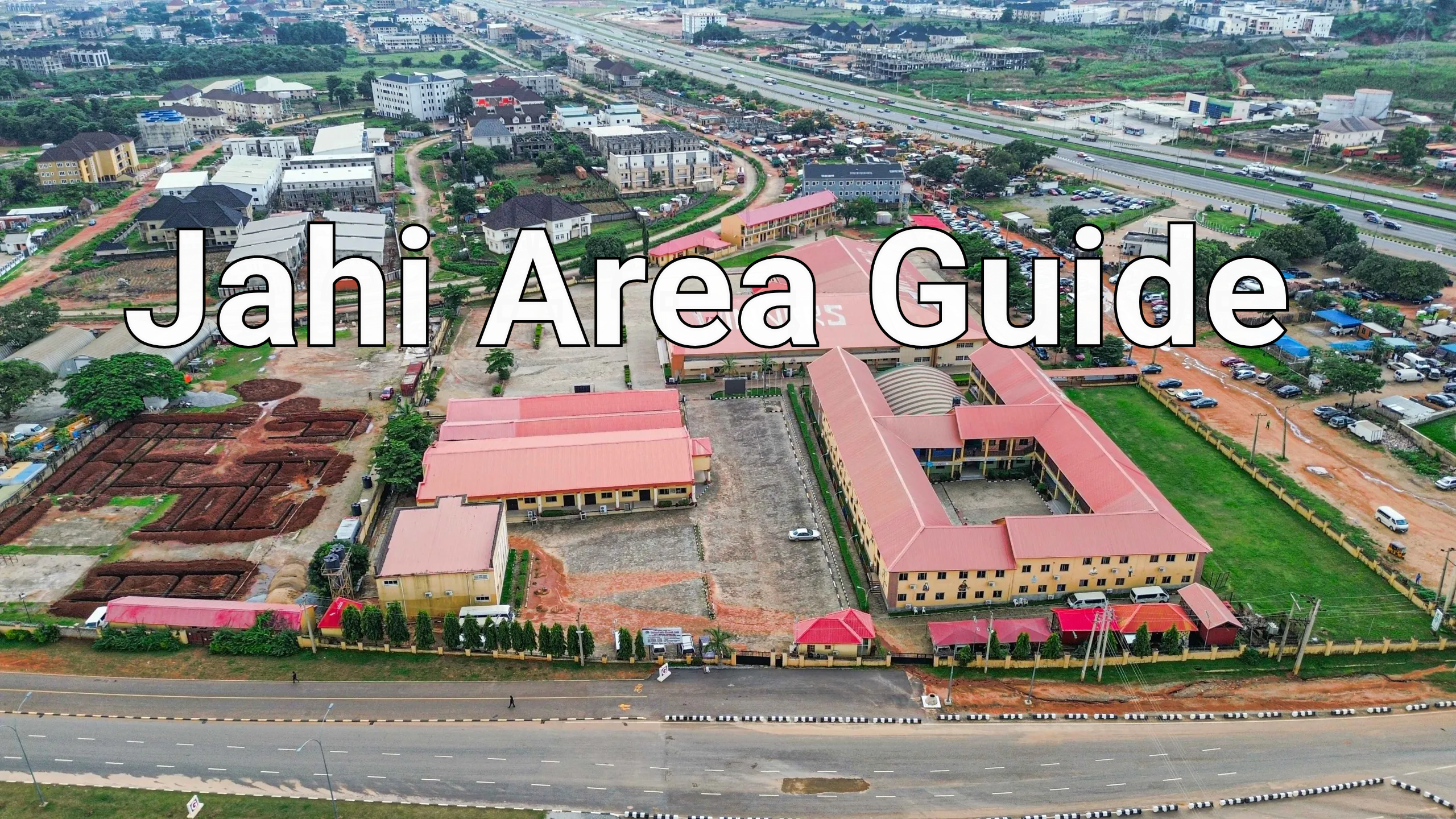
Jahi has become one of the Abuja districts that regularly appears in property searches and listings, but it is important to understand that “Jahi” is not one uniform market. Prices vary significantly depending on the exact axis, land size, title, road access, permitted use and proximity to established infrastructure.
If you are considering buying land or property in Jahi, this guide gives you a practical view of the market using current property listings and available market information, while separating asking prices from verified transaction prices.
Where Is Jahi in Abuja?
Jahi is a residential district in Abuja, positioned close to established areas including Wuse 2, Kado, Katampe and Gwarinpa, with access to several important roads connecting the district to other parts of the city.
Its location is one reason the district attracts both owner-occupiers and property investors, particularly buyers looking for a relatively central residential location without paying the prices associated with some of Abuja’s most established premium districts.
However, the exact location within Jahi matters considerably. A property around Gilmore, Jahi Main, Aduvie and other established axes can command a very different price from land farther from major access roads or in less developed portions of the district.
Is Jahi a Good Place to Buy Property?
Jahi can be attractive for both residential use and investment, but whether a particular property is a good investment depends on the specific property rather than the district name alone.
Current listings demonstrate substantial activity in the area. Nigeria Property Centre showed 150 land listings in Jahi as of August 10, 2026, including 115 listings classified as residential land. The platform reported an average asking price of ₦700 million for all land and ₦650 million for residential land. (Nigeria Property Centre)
Those figures should not be interpreted as the actual selling price of land in Jahi. They represent asking prices from properties advertised on the platform, and individual listings vary considerably in size, location, title and intended use.
For a buyer, that distinction is important because a ₦650 million average does not mean you need ₦650 million to buy land in every part of Jahi, nor does it mean every 1,000 sqm plot is worth that amount.
How Much Is Land in Jahi Abuja?
Current listings show a wide range of asking prices.
For example, recent listings include:
• 786 sqm residential plot with C of O at ₦500 million
• 863 sqm residential land at ₦550 million
• 900 sqm residential land with FCDA C of O at ₦600 million
• 1,200 sqm residential land at ₦370 million
• 1,200 sqm residential land with C of O at ₦400 million
• 1,500 sqm residential land with C of O at ₦650 million
• 1,882 sqm residential land with FCDA C of O at ₦650 million
• 2,064 sqm residential land with C of O at ₦750 million
• 2,247 sqm residential land at ₦1.6 billion
• 2,357 sqm residential land at ₦1.3 billion
• 5,000 sqm residential land at ₦2.5 billion
These are advertised prices, not confirmed completed transaction prices. Several listings also carry agency or professional fees, so buyers should calculate the total acquisition cost rather than looking only at the headline property price. (Nigeria Property Centre)
PropertyPro also currently shows multiple Jahi listings, including 1,200 sqm at ₦450 million, 1,178 sqm at ₦420 million, 2,064 sqm at ₦800 million and 5,000 sqm at ₦2.709 billion. (PropertyPro)
This illustrates why quoting one “Jahi land price” can be misleading.
What Does 5,000 sqm Cost in Jahi?
This is particularly relevant for investors looking for development land.
Current listings provide several useful comparables.
Nigeria Property Centre currently shows a 5,000 sqm residential development plot in Jahi advertised at ₦3 billion. Another 5,000 sqm residential listing is advertised at ₦2.5 billion, while has a 5,000 sqm multipurpose property listed at ₦2.709 billion.
There are also larger and differently structured transactions, including joint-venture opportunities, which should not be compared directly with outright residential land.
Based on these listings, a buyer with a ₦2 billion budget should not assume that 5,000 sqm of prime residential land in Jahi is readily available at that price. There are advertised properties around the ₦2.5 billion range, but asking prices, title, exact location and negotiation position all matter.
What About Smaller Residential Plots?
Smaller plots can still command substantial prices in established Jahi locations.
For example, a current listing shows 786 sqm of residential land with C of O at ₦500 million, while another lists 863 sqm residential land at ₦550 million. (PropertyPro)
Another current listing advertises 900 sqm residential land with FCDA C of O in Jahi Gilmore at ₦600 million. (Nigeria Property Centre)
These examples demonstrate an important point for buyers:
The price per square metre can become very high in established parts of Jahi, particularly where title, road access and surrounding development are strong.
Why Are Jahi Properties Expensive?
Several factors can influence the price of a particular property.
The first is location within the district.
The second is title.
The third is road access and infrastructure.
The fourth is permitted land use.
The fifth is plot size and development potential.
The sixth is the condition and development level of the surrounding neighbourhood.
For example, a 2,064 sqm residential property advertised near Aduvie International School is priced at ₦750 million, while a 2,247 sqm property advertised as medium-density residential land near Gilmore is priced at ₦1.6 billion. (Nigeria Property Centre)
The difference is substantial despite the relatively similar land sizes.
That is why buyers should avoid judging Jahi property solely by price per square metre.
Is Jahi Good for Building a Family Home?
Jahi can suit buyers who want to build a permanent residence while remaining relatively close to central Abuja districts.
However, the correct plot depends on the intended building.
Someone planning a single detached family home does not necessarily need the same type of land as an investor planning several apartments.
Before purchasing, establish:
• The permitted land use
• The plot size
• The title
• Access road
• Building restrictions
• Applicable development controls
• Availability of infrastructure
• Whether the proposed building is compatible with the plot’s planning designation
This is particularly important with larger plots because some Jahi properties are marketed for multi-unit or other forms of development rather than simply as plots for one family home.
Is Jahi Good for Land Banking?
Jahi can be considered for land banking, but investors should be careful about using “Jahi” alone as the investment thesis.
Land banking works when the acquisition price, location, title, development trajectory and future demand justify the holding period.
A buyer should therefore compare Jahi with alternatives such as Katampe, Kado, Guzape, Apo, Lokogoma and other Abuja districts rather than assuming that a Jahi plot will automatically provide the best return.
The more useful question is:
“What am I paying today compared with comparable locations, and what specific future development could support a higher value?”
That approach is more defensible than simply assuming that an area will appreciate because it is considered prime.
Jahi vs Other Abuja Locations
Jahi is often compared with nearby and competing residential districts.
A buyer considering Jahi may also examine:
Jahi vs Katampe
Jahi vs Kado
Jahi vs Guzape
Jahi vs Apo
Jahi vs Lokogoma
Jahi vs Wuye
Jahi vs Mabushi
The right comparison depends on the buyer’s objective.
For a family looking for a permanent residence, access to work, schools, roads and neighbourhood quality may matter most.
For an investor, acquisition price, development potential, rental demand, exit liquidity and title may matter more.
For a land banker, the entry price and future development trajectory become particularly important.
What Documents Should You Check Before Buying Land in Jahi?
Do not purchase Jahi land simply because the seller or agent describes it as “C of O.”
The buyer should establish exactly what document exists, whose name appears on it, what the land was allocated for, whether the land corresponds with the survey and whether there are restrictions or encumbrances affecting the transaction.
Depending on the transaction, documents may include:
• Certificate of Occupancy
• Right of Occupancy
• Survey plan
• Deed of Assignment
• Allocation documentation
• Building approval where applicable
• Evidence of registration
• Relevant searches and verification results
The exact documentation required depends on the property’s history and transaction structure.
Independent due diligence remains essential.
A property advertisement itself is not proof of title. Nigeria Property Centre explicitly states that information supplied in its advertisements is provided by the advertiser and that the platform does not warrant the accuracy or completeness of the advertisement. (Nigeria Property Centre)
The same principle applies across property portals.
A listing is evidence that somebody is offering a property for sale. It is not evidence that the buyer should pay.
What Should You Ask Before Buying Jahi Land?
Before inspection, establish the exact location and price.
During due diligence, establish:
• Who owns the property?
• What title exists?
• What is the property’s cadastral information?
• Does the survey correspond with the land?
• Is the land designated for the proposed use?
• Are there encumbrances?
• Are there outstanding obligations?
• Are there development restrictions?
• What additional fees will the buyer pay?
• What documents will the buyer receive after completion?
• What is the actual process for transferring the interest?
These questions become even more important when comparing properties with large differences in price.
What Is the Best Part of Jahi to Buy?
There is no reliable basis for declaring one Jahi axis universally “the best” without defining the buyer’s objective.
Gilmore, Jahi Main, areas around Aduvie and other established portions of the district appear repeatedly in current listings, but that does not automatically mean every property there is a good investment. Current listings show substantial variation in price and property characteristics even within these areas. (Nigeria Property Centre)
A better approach is to evaluate the specific property against:
Location
Title
Land use
Road access
Infrastructure
Price per square metre
Development potential
Surrounding development
Exit market
Current Jahi Property Market: What the Listings Actually Tell Us
The current listings provide three useful observations.
First, Jahi has substantial advertised supply. Nigeria Property Centre recorded 150 land listings in August 2026, including 115 classified as residential. (Nigeria Property Centre)
Second, asking prices vary dramatically. Current residential listings range from several hundred million naira for smaller plots to billions of naira for larger development sites. (Nigeria Property Centre)
Third, title and location appear repeatedly in the marketing of higher-priced properties, with several listings specifically mentioning C of O, FCDA C of O, tarred roads or established axes. These are seller claims contained in advertisements and should still be independently verified before purchase. (Nigeria Property Centre)
That makes Jahi a market where comparing several properties before buying can be more valuable than simply looking for the cheapest available plot.
Who Should Consider Buying in Jahi?
Jahi may be worth considering if you:
• Want to build a home in a relatively central Abuja location
• Prefer an established or developing residential district
• Have a substantial land acquisition budget
• Want land with development potential
• Are considering a larger residential development
• Want to compare a central location against more peripheral Abuja districts
It may be less suitable if your primary objective is simply finding the cheapest possible plot of land in Abuja.
There are other districts where the entry price can be considerably lower.
Hofesh Homes Jahi Property Opportunities
If Hofesh Homes has a currently available Jahi property that matches your requirements, it should be evaluated using the same process we recommend to every buyer, starting with the exact location, permitted use, title, documentation, asking price and independent verification.
We do not recommend buying a Jahi property simply because Jahi is considered a desirable district.
The property itself must make sense.
For buyers who are considering Jahi, Hofesh Homes can also help compare the available property against alternatives in other Abuja districts based on budget, intended use and investment objective.
Frequently Asked Questions About Jahi Abuja
Is Jahi a good place to buy land?
Jahi can be attractive for residential and development purposes, but the quality of an investment depends on the specific plot, title, location, price and permitted use rather than the district name alone.
How much is land in Jahi Abuja?
Current advertised residential land prices vary widely. Nigeria Property Centre reported an average asking price of ₦650 million for residential land in Jahi in August 2026, but individual listings range substantially above and below that figure. (Nigeria Property Centre)
How much is 5,000 sqm land in Jahi?
Current listings include 5,000 sqm residential land advertised around ₦2.5 billion and ₦3 billion, while PropertyPro has a 5,000 sqm multipurpose listing at ₦2.709 billion. These are asking prices, not verified transaction prices. (Nigeria Property Centre)
Is Jahi good for building a house?
It can be, provided the particular plot has appropriate residential designation, suitable access, acceptable documentation and sufficient space for the proposed development.
Is Jahi expensive?
Compared with many Abuja districts, established Jahi locations can command high land prices, particularly for larger residential plots with strong access and title documentation. Current listings demonstrate this clearly. (Nigeria Property Centre)
Should I buy land in Jahi or another Abuja district?
That depends on your budget, intended use, required location, holding period and investment objective. A proper comparison should look at actual comparable properties rather than relying on general statements about which district is “better.”